As a
new topic, many students will have conjured up all sorts of thoughts of
what Aikido is, and most of thoughts are probably correct. Aikido
means different things to different people.
To avoid confusion we must first look into its history.
References
to the original form, "AIKI JUJUTSU", date back to 1150ad.
This fighting form was closely guarded by the heads of Japanese
Clans in Feudal times and was only taught to the knights of the Clan.
The close combat weapons used in those days were, swords, spears,
staffs knives to name a few. In
general fighting was carried out in close quarters.
Today, as we have seen in recent times, battle is fought at distant
and with explosive weapons such as guns & bombs etc.
To use a Martial Art against such devices would be pointless.
So the reasons for learning a Martial Art today are entirely
different from the original reasons. Today it is more about leisure
and in essence the spirit of what once was. From this we can
practise and become skilful with a more useful purpose. This purpose
is the development of body and mind for the good of all.
In the
early part of this century Morihei Ueshiba (Founder if Aikido)
practised AIKI JUJUTSU and from this he derived his original form
"AIKI BUJUTSU". By
1942, "AIKIDO", as it was then to be named, was officially
recognised and was know as the way of harmony.
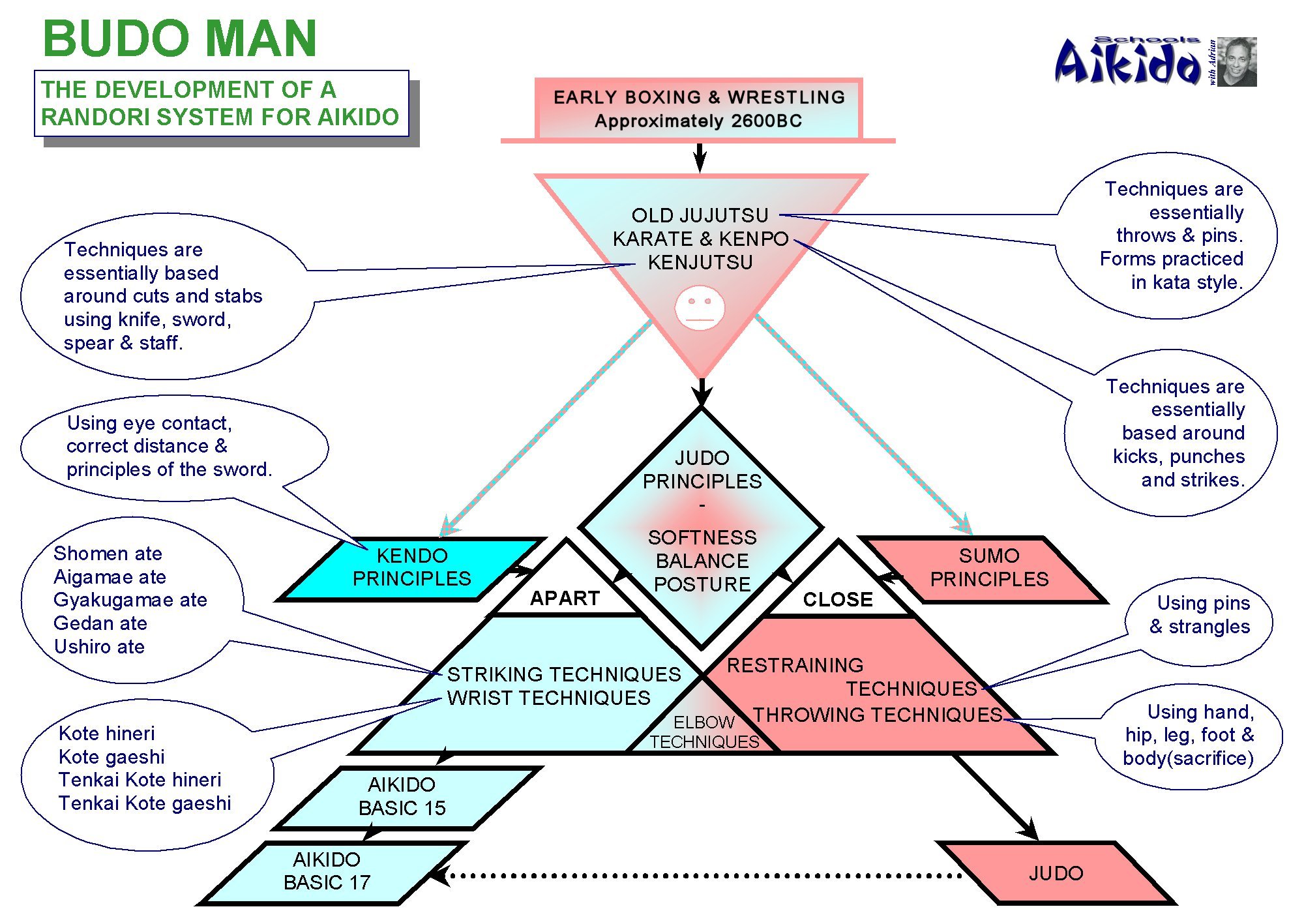
THE
DEVELOPMENT OF A RANDORI SYSTEM FOR AIKIDO
Originally
the AIKI JUJUTSU form had no simple learning process and there were many
hundreds of techniques many of which were deadly and violent.
Morihei Ueshiba's AIKIDO reduced the number to some 2664 variations
on 30 basic movements and using safer techniques.
Students could then repeatedly practice without the fear of
permanent injury, but still keeping in mind the origins of the techniques.
Kenji Tomiki, a student of Morihei Ueshiba and like his master he
too was an expert in Judo. He
took this a stage further and devised a simpler and more systematic method
of teaching Aikido efficiently from the knowledge and correct application
of far fewer techniques. One
of his aims was to introduce the element of competition or free-play
(Randori), something not previously acknowledged by Aikidoka.
By the mid 1960's he had achieved this and several colleges took
part in a competition. The
analogy being similar to that of Judo, which was developed by Kano for
younger players with a competitive and sporting element in mind.
The “BUDO
MAN” diagram shows the origins and refinements of AIKIDO and how it
relates to other disciplines. It
shows how the techniques are grouped and how they overlap with Judo.
Furthermore it highlights the key elements for safe and effective
application of Randori.
SOFTNESS
/ MOVEMENT, BALANCE & POSTURE