|
Aikido
- The Art Of Dyeing!
|
|
The
Grading - Belt System
|
|
|
|
There are five Kyu or senior student grades, before Dan
rank (Black Belt). These are indicated by different coloured belts that
the students wear. For junior students the increments are more,
with each step being easier to achieve:-
|
|
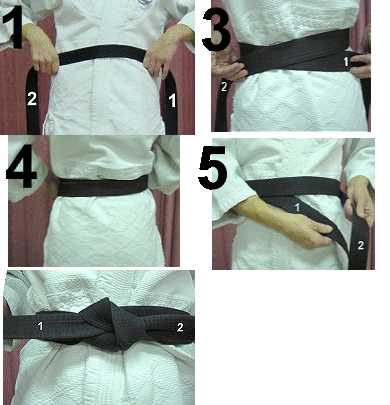
|
"HOW TO TIE YOUR BELT"
ITALIAN
"HOW TO TIE YOUR BELT" LINK
|
| Belt |
Senior Grade |
Junior Grade |
Belt |
| (Click on grade for syllabus) |
| White |
6th
Kyu |
6th Kyu |
White |
| 6th Kyu +1 mon |
White
+1 |
| 6th Kyu +2 mon |
White
+2 |
| 6th Kyu +3 mon |
White
+3 |
| Yellow |
5th
Kyu |
5th Kyu |
Yellow |
| 5th Kyu +1 mon |
Yellow
+1 |
| 5th Kyu +2 mon |
Yellow
+2 |
| 5th Kyu +3 mon |
Yellow
+3 |
| Orange |
4th
Kyu |
4th Kyu |
Orange |
| 4th Kyu +1 mon |
Orange
+1 |
| 4th Kyu +2 mon |
Orange
+2 |
| 4th Kyu +3 mon |
Orange
+3 |
| Green |
3rd
Kyu |
3rd Kyu |
Green |
| 3rd Kyu +1 mon |
Green
+1 |
| 3rd Kyu +2 mon |
Green
+2 |
| 3rd Kyu +3 mon |
Green
+3 |
| Blue |
2nd
Kyu |
2nd Kyu |
Blue |
| 2nd Kyu +1 mon |
Blue
+1 |
| 2nd Kyu +2 mon |
Blue
+2 |
| 2nd Kyu +3 mon |
Blue
+3 |
| Brown |
1st
Kyu |
1st Kyu |
Brown |
| 1st Kyu +1 mon |
Brown
+1 |
| 1st Kyu +2 mon |
Brown
+2 |
| 1st Kyu +3 mon |
Brown
+3 |
| Black |
1st
Dan |
non
junior grade |
Black |
| 2nd
Dan |
| 3rd
Dan |
| 4th
Dan |
| 5th
Dan |
| 6th
Dan |
|
|
|
The
Grading
Syllabus
|
| 6th
Kyu |
White |
Core
Skills:
Technique:
Application:
|
Unsoku
- Complete (3 Sections)
Ukemi - Side and Back breakfall
Randori-no-kata
1-5
1. Shomen-ate
2. Ai-gamae-ate
3. Gyaku-gamae-ate
4. Gedan-ate
5. Ushiro-ate
Performed on candidate's 'natural' side.
i.e. candidate's choice of left or right.
Kakarigeiko - Single attacker, Open-handed attack which must include
Shomen-ate and Yokomen-uchi.
|
Timescale:
More than 2 months from start date.
Minimum of 20 hours practise.
|
| 5th
Kyu |
Yellow |
Core
Skills:
Technique:
Application:
|
Tandoku-undo
- Sections 1-3
Ukemi - Forward Roll
Randori-no-kata (1-5
and 6-10)
1. Shomen-ate
2. Ai-gamae-ate
3. Gyaku-gamae-ate
4. Gedan-ate
5. Ushiro-ate
6. Oshi-taoshi
7. Ude-gaeshi
8. Hiki-taoshi
9. Ude-garame / Ude-hineri
10. Waki-gatame
Performed left or right, examiner's choice.
Kakarigeiko - Single attacker with or without Tanto, to include
Shomen and Yokomen (Aigamae and Gyakugamae) attacks.
See note 2
|
Timescale:
More than 2 months as 6th Kyu.
Minimum of 20 hours practise as 6th Kyu.
|
| 4th
Kyu |
Orange |
Core
Skills:
Technique:
Application:
|
Tandoku-undo
- complete (Sections 1-5)
Ukemi - Kote-gaeshi, supported
Shikko - Forward & Turning
Suwari-waza - 2 techniques
Randori-no-kata (1-5
and 6-10
and 11-14)
1. Shomen-ate
2. Ai-gamae-ate
3. Gyaku-gamae-ate
4. Gedan-ate
5. Ushiro-ate
6. Oshi-taoshi
7. Ude-gaeshi
8. Hiki-taoshi
9. Ude-garame / Ude-hineri
10. Waki-gatame
11. Kote-hineri
12. Kote-gaeshi
13. Tenkai-kote-hineri
14. Shiho-nage / Tenkai Kote Gaeshi
Performed left or right, examiner's choice.
Kakarigeiko - Grasp attacks, Aigamae and Gyakugamae.
Tanto Kakarigeiko - Single attacker with Tanto.
|
Timescale:
More than 4 months as 5th Kyu.
Minimum of 40 hours practise as 5th Kyu.
|
| 3rd
Kyu |
Green |
Core
Skills:
Technique:
Application:
|
Ukemi
- Sumi-otoshi, supported.
Suwari-waza - 4 techniques
(Candidate's choice, both students kneeling)
Randori-no-kata (17 techniques)
(1-5
and 6-10
and 11-14
and 15-17)
1. Shomen-ate
2. Ai-gamae-ate
3. Gyaku-gamae-ate
4. Gedan-ate
5. Ushiro-ate
6. Oshi-taoshi
7. Ude-gaeshi
8. Hiki-taoshi
9. Ude-garame / Ude-hineri
10. Waki-gatame
11. Kote-hineri
12. Kote-gaeshi
13. Tenkai-kote-hineri
14. Shiho-nage / Tenkai Kote Gaeshi
15. Mae-otoshi
16. Sumi-otoshi
17. Hiki-otoshi
Randori-no-kata-no-ura-waza 1-5
Counters 1-5 (5 techniques)
1. Shomen-ate - Waki-gatame
2. Ai-gamae-ate - Kote-mawashi
3. Gyaku-gamae-ate - Gedan-ate
4. Gedan-ate - Ai-gamae-ate
5. Ushiro-ate - Tenkai-kote-hineri
Kakarigeiko - Multiple attackers e.g. Ninindori, with variation of
attack, open-handed.
Hikitategeiko - Single attacker with Tanto.
Objective: Movement - 'passive' (no counters)
|
Timescale:
More than 4 months as 4th Kyu.
Minimum of 40 hours practise as 4th Kyu.
|
| 2nd
Kyu |
Blue |
Core
Skills:
Technique:
Application:
|
Ukemi
- floating/falling leaf
(Performed alone.
Similar to Koryu-Dai-San. No. 1
Suwari-waza)
Shichi-hon-no-kuzushi
1-7
(To show balance disturbance,
circular movement and control - no
breakfalls)
Randori-no-kata
1-17 (17 techniques)
Randori-no-kata-no-ura-waza 1-10
Counters 1-10
(10 techniques)
1. Shomen-ate - Waki-gatame
2. Ai-gamae-ate - Kote-mawashi
3. Gyaku-gamae-ate - Gedan-ate
4. Gedan-ate - Ai-gamae-ate
5. Ushiro-ate - Tenkai-kote-hineri
6. Oshi-taoshi - Kote-mawashi
7. Hiki-taoshi - Tenkai-kote-hineri
8. Kote-gaeshi - Kote-gaeshi
9. Tenkai-kote-hineri - Waki-gatame
10. Shiho-nage - Shiho-nage
/ Tenkai Kote Gaeshi
Kakarigeiko - Ninindori
Hikitategeiko - Single attacker with Tanto -
'active' (with counters).
|
Timescale:
More than 6 months as 3rd Kyu.
Minimum of 60 hours practise as 3rd
Kyu.
|
| 1st
Kyu |
Brown |
Core
Skills:
Technique:
Application:
|
Shichi-hon-no-kuzushi
1-14 (Omote)
plus (Urawaza)
(To show balance disturbance, circular movement
and control - with breakfalls)
Randori-no-kata 1-17 (17 techniques)
Counters 1-10
(10 techniques)
Kuzushi - Demonstration of a variety of balance
disturbances for randori.
Koryu-dai-san
1. Oshi-taoshi
2. Gyaku-gamae-ate
3. Kote-gaeshi
4. Ryote-mochi-sukui-nage
5. Tenkai-kote-hineri
6. Shiho-nage
/ Tenkai Kote Gaeshi
7. Gedan-ate
8. Hiji-kime
Suwari-waza Section A (8 techniques)
Hikitategeiko - Empty-handed (Toshu)
|
Timescale:
More than 9 months as 2nd Kyu.
Minimum of 120 hours practise as 2nd
Kyu.
|
|
Notes:
2. Candidate: From 5th Kyu onwards, and
with the exception of Koryu-Dai-San, candidates will be expected to be
able to demonstrate on left or right at examiner's choice.
3. Coaches: Gohon-no-Kuzushi, currently
shown in BAA syllabus at 2nd Kyu, is recognised as a training method and
should be incorporated into practice sessions.
4. Coaches: Tanto Randori-no-Kata is
recognised as a training method and should be incorporated into practice
sessions.
5. At all levels after 6th Kyu,
previous syllabus will be required at the discretion of the examiners.
6. Duration, intensity and quantity of
the ‘Application’ sections will be at the discretion of the
examiners.
|
|
|
|
|
|
|
|
|
| 1st
Dan |
Black |
Technique:
Application:
|
Koryu-Dai-San -Section B and C
- 16 (8+8)
Koryu-Dai-Yon complete - 1-25 (14+11) note1/2
Randori - Tanto and Toshu
(empty-handed)
Combinations and Counters - 5 of each, candidates' choice
|
Timescale:
1 year consistent
practice as 1st Kyu |
| 2nd
Dan |
Black |
Technique:
Application:
|
Koryu-Dai-San
- Section D, E and F - 18 (5+5+8)
Koryu-Dai-Ichi, Section A - 1-5
Randori as required - Tanto and Toshu
|
Timescale:
2 years consistent
practice as 1st Dan |
| 3rd
Dan |
Black |
Technique:
Application:
|
Koryu-Dai-San
complete - 1-50 (8+8+8+5+5+8+8)
Koryu-Dai-Ichi complete - 1-24 (5+7+6+6)
Randori as required - Tanto and Toshu
|
Timescale:
3 years consistent
practice as 2nd Dan |
| 4th
Dan |
Black |
Technique:
Application:
|
Koryu-Dai-Ni
complete - 16 (11+5)
Goshin-ho-no-Kata - 1-19 (8+5+2+2+2)
Randori as required - Tanto and Toshu
|
Timescale:
4 years consistent
practice as 3rd Dan |
| 5th
Dan |
Black |
Technique:
Application:
|
Koryu-Dai-Go
complete - 23 (7+5+6+5)
Goshin-ho-no-Kata - 20-37
Randori as required - Tanto and Toshu
|
Timescale:
5 years consistent
practice as 4th Dan |
| 6th
Dan |
Black |
Technique:
Application:
|
Koryu-Dai-Roku
- 39 (5+10+7+5+4+4+4) Note 3
Goshin-ho-no-Kata - +15
Randori as required - Tanto and Toshu
|
Timescale:
6 years consistent
practice as 5th Dan |
|
Notes:
1. Candidates: Koryu-no-Kata – sections to be
demonstrated will be chosen by the examiner.
2. Examiner: Koryu-no-Kata – new sections at each
level must be demonstrated, demonstration of previous sections is
optional.
3. Candidates: Upon attaining 6 Dan, students will have
successfully performed all the current Koryu-no-Kata; Koryu-Dai-Ichi,
Koryu-Dai-Ni, Koryu-Dai-San, Koryu-Dai-Yon, Koryu-Dai-Go, Koryu-Dai-Roku.
4. At any time examiners may ask to review previous
parts of the syllabus.
5. Character and attitude will be considered at each
level. These include participation as a student in competitions and/or
courses.
6. ‘Technique’ and ‘Application’ sections are of
equal value in the assessment.
7. Age and physical ability will be taken into account
throughout.
|
|
|